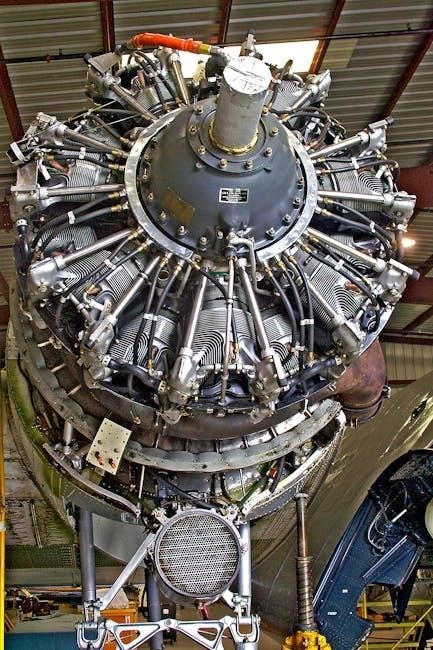
Pulse Detonation Engines (PDEs) utilize detonations of fuel-oxidizer mixtures for propulsion, offering theoretical efficiency gains from Mach 0 to 5.
What is a Pulse Detonation Engine (PDE)?
A Pulse Detonation Engine (PDE) represents a revolutionary approach to propulsion, distinctly differing from conventional engines. It operates by repeatedly detonating a mixture of fuel and oxidizer within a tube. This detonation process generates thrust, and crucially, the mixture must be refreshed between each detonation wave.
Unlike traditional engines relying on deflagration (subsonic combustion), PDEs harness the power of detonation – a supersonic combustion wave. This fundamental difference allows for potentially higher thermodynamic efficiency. The engine’s pulsed nature is inherent to the process, dictating the cycle of initiation, detonation, and exhaust.
Historical Context: Early Concepts (1940s)
The foundational concepts behind Pulse Detonation Engines (PDEs) trace back to the 1940s, marking the earliest explorations into detonation-based propulsion. While specific details of these initial investigations remain limited, they laid the groundwork for decades of subsequent research.
These early ideas stemmed from a desire to improve engine efficiency and explore alternative combustion methods. The theoretical advantages of detonation – rapid compression and constant volume heat addition – were recognized even then. However, significant technological hurdles prevented practical realization during that era, delaying substantial progress for many years.
Current Status: Research and Development (as of 05/04/2026)
As of May 4th, 2026, Pulse Detonation Engine (PDE) technology remains largely in the research and development phase. Despite decades of investigation, no PDE has transitioned into full-scale production for practical applications. Numerous testbed engines have been constructed and rigorously tested by various research institutions and organizations.
A significant milestone was achieved in 2008 with a successful flight demonstration. However, ongoing challenges related to fuel-oxidizer mixing, detonation stability, and material durability continue to impede widespread adoption. Current efforts focus on overcoming these obstacles to unlock the PDE’s potential.
Principles of Operation
PDEs function by initiating detonation waves within pulsed fuel-oxidizer mixtures, rapidly compressing and heating the gases to generate thrust through controlled explosions.
The Detonation Wave
Detonation, unlike deflagration (combustion), is a supersonic combustion process characterized by a shock wave propagating through the fuel-oxidizer mixture. This shock wave intensely compresses and heats the gases, initiating a rapid, self-sustaining reaction. The resulting energy release occurs almost instantaneously at constant volume, a key factor in the PDE’s thermodynamic advantages.
This wave travels faster than the speed of sound in the unreacted mixture, creating a highly efficient energy conversion. The rapid compression and heat addition distinguish detonation from conventional combustion, enabling potentially higher thermodynamic efficiencies. Maintaining a stable and controlled detonation wave is crucial for PDE operation.
Fuel-Oxidizer Mixing Process
Efficient mixing of fuel and oxidizer is paramount for successful detonation within a Pulse Detonation Engine (PDE). The mixture must be homogeneous to ensure a consistent and reliable detonation wave propagation. Inadequate mixing leads to incomplete combustion and reduced performance.
Achieving rapid and thorough mixing within the short timeframe of a pulse cycle presents a significant engineering challenge. Various techniques, including strategically placed injectors and tube geometries, are employed to enhance mixing. This process directly impacts the engine’s efficiency and stability, requiring precise control and optimization.
Pulse Cycle: Initiation, Detonation, and Exhaust
The PDE operates in a cyclical manner: initiation, detonation, and exhaust. First, a fresh fuel-oxidizer mixture is rapidly introduced into the detonation tube. Next, an ignition source initiates detonation, creating a supersonic shockwave that rapidly compresses and heats the mixture. This detonation generates high-pressure gases.
Finally, these gases are expelled through a nozzle, producing thrust. The cycle repeats rapidly, typically at frequencies of 80 Hz or higher, renewing the mixture for subsequent detonations. This pulsed nature distinguishes PDEs from continuous combustion engines.
Thermodynamic Advantages
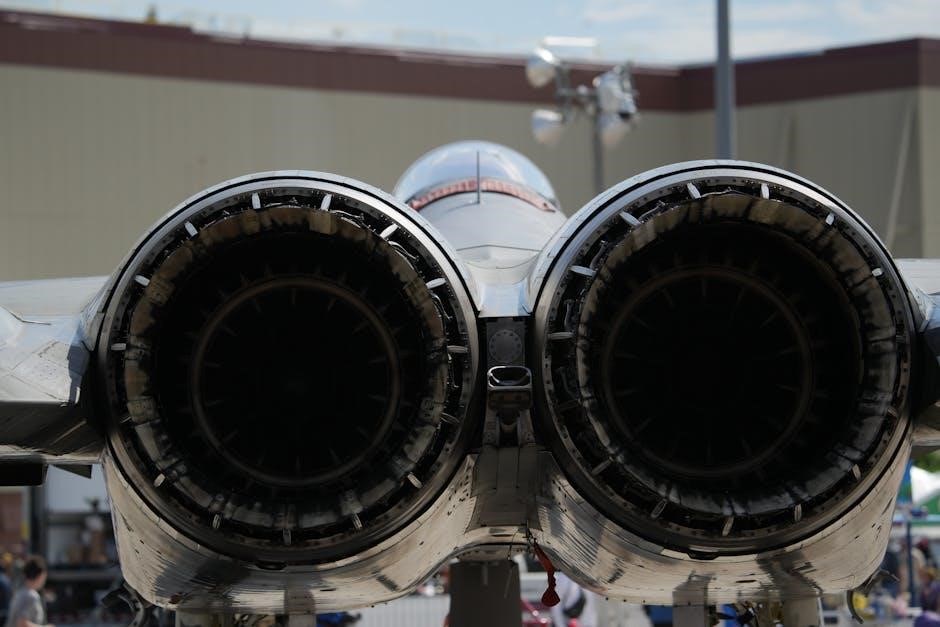
PDEs boast higher thermodynamic efficiency due to constant volume heat addition during detonation, potentially reducing component complexity and eliminating the need for compressors.
Constant Volume Heat Addition
A key thermodynamic benefit of Pulse Detonation Engines (PDEs) stems from the process of constant volume heat addition. Unlike traditional engines where combustion occurs with volume changes, detonation rapidly compresses the fuel-oxidizer mixture. This compression and subsequent heat release happen almost instantaneously at a fixed volume.
This characteristic leads to a more efficient energy conversion, as the work output is maximized. The rapid compression also contributes to a higher peak pressure and temperature, further enhancing the engine’s thermodynamic performance. Consequently, PDEs theoretically surpass the efficiency limits of conventional cycle engines, offering a significant advantage in propulsion systems.
Higher Thermodynamic Efficiency Compared to Traditional Engines
Pulse Detonation Engines (PDEs) demonstrate the potential for superior thermodynamic efficiency when contrasted with conventional engine designs like turbojets and turbofans. This advantage arises from the detonation process itself, which rapidly compresses the fuel-air mixture and introduces heat at a nearly constant volume.
This contrasts with the constant-pressure heat addition in traditional engines, resulting in a more efficient energy conversion. An ideal PDE design can achieve a higher thermodynamic efficiency, potentially reducing fuel consumption and increasing range. This efficiency gain is a primary driver for ongoing research and development efforts.
Potential for Reduced Component Complexity
Pulse Detonation Engines (PDEs) offer a compelling possibility: a reduction in the number of necessary engine components. Traditional engines heavily rely on compressors and turbines for air intake and exhaust, adding significant weight and complexity. However, the detonation wave within a PDE rapidly compresses the mixture, potentially eliminating the need for these rotating components.
Consequently, a simplified PDE design could lead to lower manufacturing costs, reduced maintenance requirements, and a lighter overall engine weight, contributing to improved aircraft performance and operational efficiency. This simplification is a key area of investigation.

Key Components of a PDE
Essential PDE components include detonation tubes, a fuel injection system, an oxidizer supply, and a reliable ignition system for initiating each pulse.
Detonation Tubes
Detonation tubes are the core of a Pulse Detonation Engine (PDE), serving as the chambers where the fuel-oxidizer mixture undergoes detonation. These tubes are meticulously designed to withstand the intense pressures and temperatures generated by the rapid combustion process. Typically, a PDE utilizes multiple tubes arranged in a configuration to achieve continuous thrust.
The geometry of these tubes – their length and diameter – significantly impacts the engine’s performance, influencing detonation wave propagation and stability. Materials used in their construction must exhibit high heat resistance and durability to endure repeated detonation cycles. Efficient heat management within the tubes is crucial for preventing material failure and maintaining optimal engine operation.
Fuel Injection System
The Fuel Injection System is critical for delivering a precisely metered amount of fuel into the detonation tubes. Achieving efficient and rapid mixing of fuel with the oxidizer is paramount for successful detonation. This system must operate with high speed and accuracy to synchronize with the pulse cycle of the engine.
Various injection strategies are employed, including direct injection and pre-mixing techniques, each with its own advantages and challenges. The design must ensure uniform fuel distribution within the tube to promote complete and stable detonation. Precise control over injection timing and quantity is essential for optimizing engine performance and preventing instabilities.
Oxidizer Supply System
The Oxidizer Supply System delivers the necessary oxidizing agent – typically air or pure oxygen – to support combustion within the detonation tubes. Utilizing air simplifies the system but reduces detonation velocity, while pure oxygen enhances performance but requires complex storage and handling.
The system must provide a consistent and controlled flow of oxidizer, synchronized with the fuel injection to achieve the optimal fuel-oxidizer mixture ratio. Efficient delivery is crucial for maximizing thrust and minimizing unburned fuel. Careful consideration must be given to pressure regulation and flow control to ensure stable detonation.
Ignition System
The Ignition System initiates the detonation process within each detonation tube. While the engine relies on detonation – a supersonic combustion wave – an initial energy source is needed to trigger it. This system must reliably and rapidly ignite the fuel-oxidizer mixture with precise timing.
Common ignition methods include spark plugs, laser-induced plasma, or even a small pilot detonation. The system’s design must withstand the harsh environment of repeated detonations and ensure consistent ignition across all tubes for stable engine operation. Reliable ignition is paramount for sustained thrust production.

Fuel and Oxidizer Considerations
PDEs can utilize various fuels, including refined kerosene, and operate with air or pure oxygen as the oxidizer, impacting performance and engine design.
Common Fuel Choices
Pulse Detonation Engines demonstrate flexibility in fuel selection, though finding optimal choices remains a key research area. Developers have considered and tested numerous options, seeking those that maximize detonation performance and engine efficiency. Refined kerosene proved successful in the 2008 Borealis flight demonstration, showcasing its viability for sustained PDE-powered flight.
Other potential fuels include hydrocarbons like methane and ethylene, offering varying energy densities and detonation characteristics. The selection process involves balancing factors such as fuel availability, cost, storage requirements, and compatibility with the engine’s operating parameters. Further investigation into advanced fuel formulations could unlock even greater performance potential for PDE technology.
Oxidizer Options (Air, Oxygen)
Pulse Detonation Engines can utilize various oxidizers, with air and pure oxygen being the primary contenders. Employing atmospheric air simplifies the system, eliminating the need for onboard oxygen storage, but reduces detonation velocity and efficiency. Utilizing pure oxygen significantly enhances performance, enabling faster detonation speeds and higher thermodynamic cycles.
However, oxygen systems introduce complexities related to storage, handling, and safety. The choice between air and oxygen depends on the specific application and performance requirements. Research explores oxygen-enriched air as a compromise, balancing performance gains with system simplicity.
Fuel-Oxidizer Mixture Ratios
Optimal fuel-oxidizer ratios are crucial for efficient detonation in Pulse Detonation Engines. These ratios dictate the completeness of combustion and detonation wave strength. Stoichiometric mixtures, where fuel and oxidizer react completely, are a starting point, but often lean or rich mixtures are preferred.
Lean mixtures enhance detonation velocity, while rich mixtures can improve energy release. Precise control is vital, as deviations can lead to incomplete combustion or detonation failure. Developers have tested various fuels, refining mixture ratios for maximum thrust and stability. Achieving the correct ratio is a key challenge in PDE development.

Challenges in PDE Development
Key hurdles include efficient mixing, preventing detonation instabilities, and ensuring tube durability under intense heat and pressure, hindering practical PDE production.
Efficient Fuel-Oxidizer Mixing
Achieving rapid and thorough mixing of fuel and oxidizer is paramount for successful detonation. Incomplete mixing leads to inefficient combustion and reduced thrust. The short pulse cycle time demands extremely fast mixing processes, presenting a significant engineering challenge.
Researchers are exploring various techniques, including advanced fuel injection strategies and optimized tube geometries, to enhance mixing efficiency. The goal is to create a homogeneous mixture before detonation initiation, maximizing energy release and overall engine performance. This remains a critical area for ongoing development and refinement within PDE technology.
Preventing Detonation Instabilities
Detonation instabilities pose a major hurdle in PDE development. Uncontrolled or erratic detonation waves can lead to engine damage, reduced performance, and even catastrophic failure. These instabilities arise from complex interactions between the detonation wave, fuel-oxidizer mixture, and tube geometry.
Researchers are actively investigating methods to stabilize the detonation process, including precise control of fuel injection timing and mixture ratios. Advanced diagnostic tools are employed to monitor detonation wave behavior and identify potential instability triggers. Maintaining stable and predictable detonation is crucial for reliable PDE operation.
Tube Durability and Heat Management
Detonation tubes endure extreme thermal and mechanical stresses with each pulse. The rapid combustion generates intense heat, potentially leading to material fatigue, erosion, and structural failure. Effective heat management is therefore paramount for long-term engine reliability.
Current research focuses on developing advanced tube materials with high temperature resistance and improved cooling strategies. These include incorporating regenerative cooling systems and exploring novel materials like ceramic matrix composites. Ensuring tube durability is critical for sustained PDE operation and practical applications.

Integration with Airframe
Optimal airflow via inlet design and thrust maximization through nozzle configuration are crucial for successful PDE integration with an airframe.
Inlet Design for Optimal Airflow
Achieving efficient airflow into the detonation tubes is paramount for PDE performance. The inlet must deliver a consistent and uniform fuel-oxidizer mixture, managing shockwave dynamics effectively. Designs need to minimize flow separation and turbulence, ensuring stable detonation initiation.
Considerations include the inlet’s geometry – whether it’s a simple open intake or a more complex diffuser – and its ability to handle varying flight speeds. Proper inlet design directly impacts the engine’s ability to sustain continuous pulsed detonation, maximizing thrust and overall efficiency. Careful aerodynamic modeling is essential.
Nozzle Design for Thrust Maximization
Optimizing the nozzle is crucial for converting the energy released during detonation into propulsive thrust. Unlike traditional engines, PDEs present unique challenges due to the pulsed nature of their exhaust. Nozzle geometry must efficiently expand the detonation products, maximizing exhaust velocity and minimizing energy loss.
Designs often explore variations in convergent-divergent shapes, tailored to the specific detonation wave characteristics. Managing shockwaves within the nozzle is vital to prevent flow separation and ensure stable thrust production. Effective nozzle design directly influences the engine’s overall performance and efficiency.
Engine Placement and Aerodynamic Effects
Strategic engine placement significantly impacts aircraft performance with PDEs. Integrating these engines alters airflow patterns, creating complex aerodynamic interactions. Careful consideration must be given to minimize drag and maximize thrust benefits.
Placement affects inlet performance and exhaust plume dispersion, influencing overall stability. The 2008 Borealis flight utilized a modified Long-EZ, requiring substantial aerodynamic adjustments. Analyzing interference drag and ensuring proper airflow management are critical for successful PDE integration into an airframe, optimizing flight characteristics.

The 2008 Borealis Flight Demonstration
The Borealis, a modified Long-EZ, achieved the first successful flight powered by a pulse detonation engine on January 31, 2008, demonstrating PDE viability.
Project Background: NASA and Innovative Scientific Solutions, Inc.
The groundbreaking 2008 flight was a collaborative effort between NASA and Innovative Scientific Solutions, Inc., aiming to validate the theoretical potential of Pulse Detonation Engines (PDEs). NASA provided funding and expertise, while Innovative Scientific Solutions, Inc. spearheaded the engine design, fabrication, and integration. This partnership sought to move PDE technology beyond simulations and laboratory testing, demonstrating sustained, powered flight.
The project’s core objective was to prove that a PDE could reliably generate thrust and control detonation cycles within the dynamic environment of an airborne platform. This demonstration was a crucial step towards assessing the feasibility of PDEs for future high-speed propulsion systems.
Aircraft Selection: Modified Long-EZ
The choice of a heavily modified Long-EZ aircraft for the 2008 flight demonstration wasn’t arbitrary. Its canard design offered inherent stability, crucial for testing a novel propulsion system like a Pulse Detonation Engine (PDE). The Long-EZ’s relatively simple construction and ample internal volume facilitated the integration of the four-tube PDE and associated support systems.
Extensive modifications were necessary to accommodate the PDE, including structural reinforcements and adjustments to the aircraft’s control surfaces. Named _Borealis_, this unique aircraft served as a cost-effective and adaptable platform for pushing the boundaries of PDE technology.
Engine Specifications: Four-Tube PDE, 80 Hz Frequency, 200 lbs Thrust
The experimental PDE integrated into the Borealis aircraft comprised four detonation tubes, strategically configured to maximize thrust and stability. These tubes operated at a pulse detonation frequency of 80 Hz, meaning 80 detonations occurred per second, generating a rhythmic thrust profile. The engine was capable of producing up to 200 pounds of thrust (approximately 890 Newtons), sufficient for sustained, albeit low-speed, flight.
This configuration represented a significant milestone, demonstrating the feasibility of generating controlled thrust using pulsed detonation technology.
Fuel Used in the Flight
During the historic 2008 flight of the Borealis, a refined kerosene-based fuel was selected to power the four-tube pulse detonation engine. Engine developers had extensively tested numerous fuel options in preceding years, evaluating their detonation characteristics and performance within the PDE’s unique combustion cycle. Kerosene proved optimal, offering a balance of energy density, detonation velocity, and practical handling considerations.
The choice underscored the importance of fuel selection in achieving stable and efficient detonation-based propulsion.
Performance Characteristics
PDEs theoretically achieve speeds from subsonic to Mach 5, with high thrust-to-weight ratios and specific impulse considerations impacting overall efficiency.
Theoretical Speed Range (Subsonic to Mach 5)
Pulse Detonation Engines demonstrate a remarkably broad theoretical operational speed range, spanning from subsonic velocities all the way up to approximately Mach 5. This capability stems from the engine’s unique detonation-based combustion process, which efficiently generates thrust across a wide spectrum of flight conditions. Unlike traditional jet engines that struggle with efficiency at higher Mach numbers, PDEs maintain potential performance.
However, achieving optimal performance across this entire range requires sophisticated control systems and careful management of the detonation waves. Practical limitations currently restrict sustained operation at the upper end of this theoretical spectrum, but ongoing research aims to unlock the full potential of PDE technology for hypersonic flight.
Thrust-to-Weight Ratio Potential
Pulse Detonation Engines offer a significant potential for achieving high thrust-to-weight ratios compared to conventional propulsion systems. This advantage arises from the engine’s simplified design, potentially eliminating components like compressors and turbines found in traditional jet engines. The Borealis demonstrator aircraft utilized a four-tube PDE generating 200 lbs of thrust.
Reduced component count translates directly into lower engine weight, boosting the overall thrust-to-weight ratio. While current prototypes are still under development, theoretical models suggest PDEs could surpass the performance of existing engines, enabling faster acceleration and improved maneuverability in future aircraft.
Specific Impulse Considerations
Specific impulse (Isp), a measure of engine efficiency, is a crucial factor in PDE performance evaluation. While PDEs theoretically boast higher thermodynamic efficiency, achieving optimal Isp in practice presents challenges. The rapid combustion and constant volume heat addition contribute to potential gains, but incomplete combustion or inefficient mixing can reduce Isp.
Current research focuses on optimizing fuel-oxidizer mixtures and injection strategies to maximize combustion efficiency. The 2008 Borealis flight demonstrated sustained PDE-powered flight, providing valuable data for Isp analysis and refinement. Further development aims to bridge the gap between theoretical potential and real-world performance.

Future Research Directions
Ongoing research prioritizes advanced fuel injection, improved tube materials for durability, and sophisticated control systems to ensure stable, sustained detonation cycles.
Advanced Fuel Injection Techniques
Efficient fuel-oxidizer mixing remains a critical challenge in PDE development. Current research explores innovative injection strategies beyond simple port injection. These include direct injection systems, utilizing high-pressure atomization to create finer fuel droplets for rapid mixing with the oxidizer.
Researchers are also investigating pulsed fuel injection, synchronizing fuel delivery with the detonation cycle to optimize mixture homogeneity. Furthermore, swirl injectors and advanced nozzle designs are being tested to enhance turbulence and promote complete mixing within the detonation tube. Computational Fluid Dynamics (CFD) modeling plays a vital role in optimizing these techniques before physical prototyping, accelerating the development process.
Improved Tube Materials and Cooling Strategies
Tube durability and heat management are significant hurdles for PDE longevity. Detonation generates extreme temperatures and pressures, demanding robust materials. Research focuses on high-temperature alloys, ceramics, and composite materials capable of withstanding these harsh conditions.
Active cooling strategies are also crucial. Techniques like regenerative cooling, where fuel is circulated around the tube to absorb heat before injection, are being investigated. Film cooling, introducing a thin layer of coolant along the tube walls, offers another potential solution. Advanced thermal barrier coatings further protect the tube material from extreme heat flux, extending its operational lifespan.
Control Systems for Stable Detonation
Preventing detonation instabilities is paramount for reliable PDE operation. Achieving consistent, controlled detonations requires precise timing and fuel-oxidizer mixture control. Sophisticated control systems are being developed to monitor and adjust these parameters in real-time.
Feedback loops utilizing pressure sensors and optical diagnostics are essential for detecting and mitigating unwanted detonation modes. Algorithms predict and counteract instabilities before they escalate, ensuring stable thrust production. Furthermore, research explores active control methods, like pulsed fuel injection and variable geometry detonation tubes, to optimize detonation characteristics.